
Under-eye surgery · 하안검
Lower Blepharoplasty — Eye Bag Removal Surgery in Seoul
Medically reviewed by Dr. Lee Young-geun, board-certified plastic surgeon · Last reviewed:
When the problem is no longer only fat but skin as well, the lower eyelid has to be re-draped rather than emptied. Done conservatively, it takes ten years off the eye; done aggressively, it pulls the lid down. The difference is millimetres.
Quick answer
Lower blepharoplasty is eye bag surgery for patients whose lower-eyelid skin has become loose as well. Dr. Lee Young-geun treats the fat and trims the excess skin through an incision just below the lashes, supporting the corner of the eye so its shape is kept. It suits eye bags with creped, sagging skin.
Medically reviewed by Dr. Lee Young-geun, board-certified plastic surgeon · Last reviewed
Overview
What lower blepharoplasty actually solves
Lower blepharoplasty (하안검수술) is the operation for a lower eyelid that has passed the stage where fat alone explains the problem. The skin has lost elasticity, fine wrinkles gather when you smile, and the bag is accompanied by a slack lid that no longer sits tight against the eye.
Unlike a purely internal approach, this operation is performed from the outside, through a fine incision hidden immediately below the lash line. That access allows three things at once: the fat can be repositioned or conservatively reduced, the muscle layer can be re-suspended, and a measured strip of excess skin can be removed.
The risk of this operation is well known in plastic surgery: remove one millimetre too much skin, or fail to support a lax lid, and the lower lid rounds or pulls away from the eye. Dr. Lee's approach is deliberately conservative — the lid is supported first and trimmed last, and the skin excision is measured with the patient looking up and with the mouth open.
Terminology
What lower blepharoplasty is also called
“Lower blepharoplasty” is the surgical name. In everyday English this is what people mean by eye bag surgery or lower eyelid surgery when the skin itself has become loose as well.
- Lower eyelid lift
- Subciliary blepharoplasty
- Skin-muscle flap blepharoplasty
- Eye bag removal surgery
- Eye bag surgery
- Lower eyelid surgery
- Under-eye surgery
- Skin pinch blepharoplasty
If you were told one of these names abroad, you are on the right page — they describe the operation Dr. Lee performs as lower blepharoplasty (하안검) here in Sinsa, Gangnam, Seoul.
Compare all four eye bag surgery options Eyelid surgery guide: upper, lower, double eyelid, ptosis
Candidacy
Who this procedure is — and is not — for
We would rather turn an operation down than perform one that will not help you. These are the honest boundaries of this procedure.
A good candidate
- Eye bags accompanied by loose or crepey lower eyelid skin
- Fine wrinkles under the eye that remain visible at rest
- Patients typically in their forties and above
- Previous filler or fat grafting that has not solved a skin problem
- Anyone who has been told they 'look tired' regardless of how much they sleep
Better served by something else
- Good skin tone with a pure fat bulge — fat repositioning alone is less invasive
- Severe lower lid laxity or previous lid retraction without a full specialist assessment
- Active eye disease, uncontrolled dry eye or recent LASIK without clearance
- Anyone unwilling to accept a fine external incision line during the first months
The detail that decides the result
Support before excision
Almost every lower eyelid complication in the literature comes from the same error: skin was treated as the problem and removed generously, without testing whether the lid could hold its own position afterwards.
At SINSA L the sequence is inverted. Lid tone is tested before the first incision. If the lid is lax, canthal support is planned as part of the operation, not added as a rescue. Only then is skin re-draped and trimmed — with the smallest excision that produces a smooth lid.
Surgical sequence
How lower blepharoplasty is performed at SINSA L
Every step below is carried out by Dr. Lee Young-geun himself, from the first marking to the final suture.
Lid-tone testing
Snap-back and distraction tests establish how much support the lower lid needs. This decides the operation, not the amount of visible skin.
Subciliary access
A fine incision immediately below the lashes, placed within the natural crease so the final line is difficult to find once healed.
Skin-muscle flap
Skin and orbicularis muscle are raised together as one layer, which preserves blood supply and reduces the risk of a thin, contracted lid.
Fat handled, not simply removed
Where a tear trough exists, the fat is transposed over the rim exactly as in the repositioning operation. Only genuinely surplus fat is reduced.
Muscle re-suspension and canthal support
The orbicularis is re-suspended upward and outward; a canthopexy is added when the lid needs it. This is what protects the lid shape long-term.
Minimal skin excision
With the patient looking up and the mouth open, the smallest safe strip of skin is marked and removed, then closed with fine sutures.
Before & after
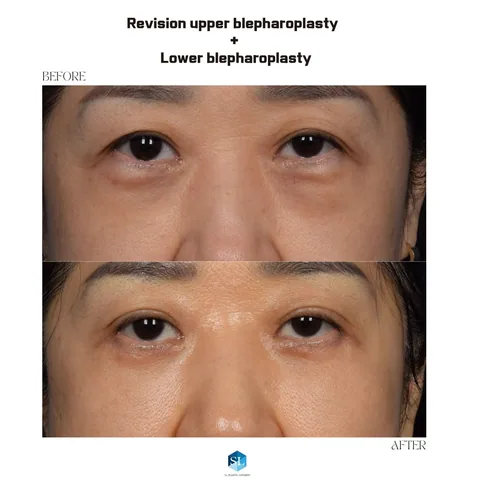
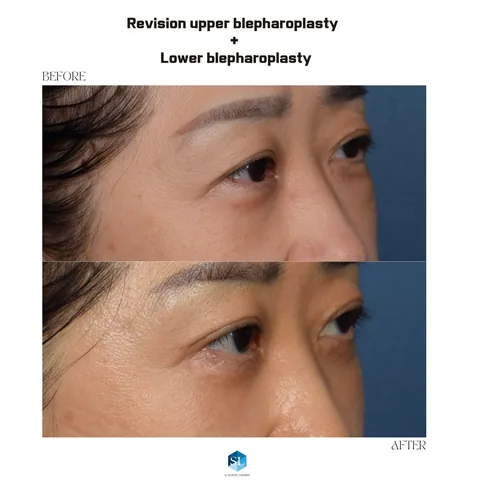
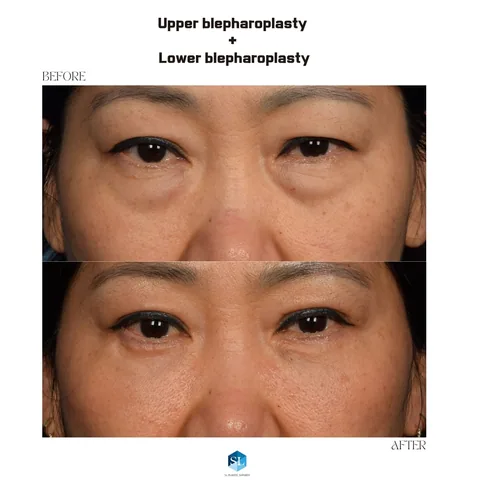
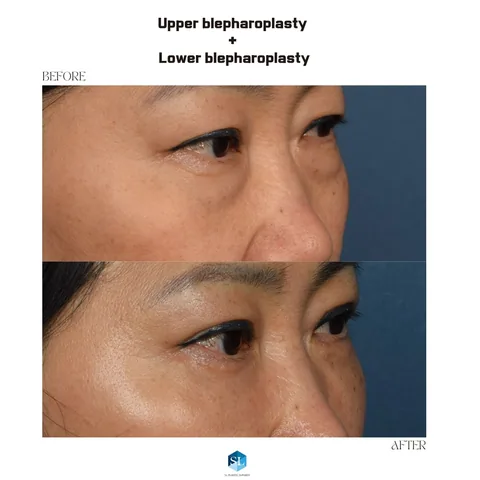
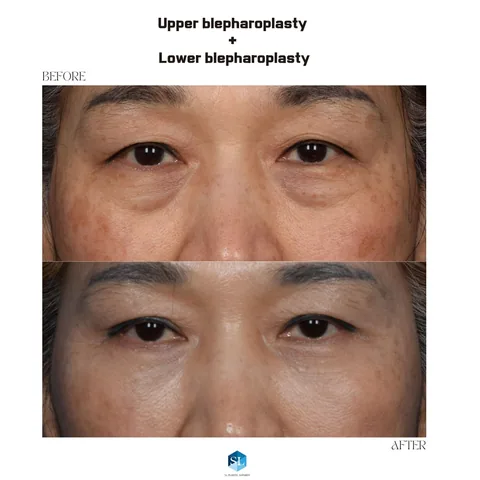
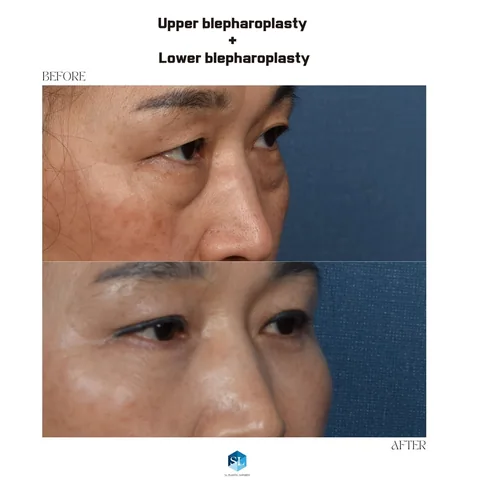
Lower Blepharoplasty results, photographed the same way every time
Standardised distance, lighting and angle. Each photograph is a consented patient of SINSA L Plastic Surgery Clinic in Gangnam, Seoul, Korea, and every case shown was operated by Dr. Lee Young-geun himself.
Recovery
What the healing actually looks like
Timelines vary between patients. These are the ranges we tell our own patients to plan around — not best cases.
Every follow-up appointment is with Dr. Lee. If something worries you between visits, you reach the clinic directly — there is no call centre in between.
| Day 0-2 | Cold compression and head elevation. Swelling and bruising are expected. |
|---|---|
| Day 5-7 | Sutures removed. Bruising is usually concealable with make-up from this point. |
| Week 2-3 | Most swelling resolved; the incision line is pink and fading. |
| Week 4-6 | Normal social appearance. Scar care and sun protection continue. |
| Month 3-6 | The line becomes difficult to see; the final lid shape is settled. |
Risks & honesty
What can go wrong
Swelling, bruising, temporary dry eye or watering, transient lower lid stiffness, visible incision line during early healing, asymmetry, and — uncommonly — lid rounding or retraction requiring correction. Careful candidate selection, canthal support where indicated and conservative skin excision are the three things that most reduce these risks.
Surgical results differ from person to person according to anatomy, skin quality, age and healing response. Every procedure carries risk, including bruising, swelling, asymmetry and the possibility of revision. The content on this site is general information, not a diagnosis or a guarantee of outcome. A face-to-face consultation with Dr. Lee is required before any operation is planned.
How the four under-eye operations compare
Each operation answers a different kind of under-eye. Dr. Lee chooses after examining the bulge, the groove and the skin.
| Operation | Best for | Approach | What happens to the fat | Operating time |
|---|---|---|---|---|
| Under-eye fat repositioning | A bulge with a tear-trough groove beneath it | Inside the eyelid, no external scar | Moved down into the groove, septum reinforced | About 40-60 minutes |
| Under-eye fat removal | A bulge with firm skin and no groove | Inside the eyelid, no visible scar | Taken out | About 30-40 minutes |
| Lower blepharoplasty | A bulge with loose, creped skin | Fine line just under the lash line | Treated, with excess skin trimmed and the eye corner supported | About 60-90 minutes |
| Micro fat grafting | A hollow with no significant bulge | Needle-sized entry points | The patient's own fat added in tiny droplets | About 40-60 minutes |
FAQ
Lower Blepharoplasty — frequently asked questions
What is the difference between lower blepharoplasty and under-eye fat repositioning?
Fat repositioning is performed from inside the eyelid and treats fat and the tear trough without touching the skin. Lower blepharoplasty is performed through a fine incision under the lashes and additionally addresses loose skin, wrinkles and lid laxity. The deciding question is whether your skin still retracts well — if it does, the internal approach is usually enough.
Will the scar be visible?
The incision sits immediately under the lash line inside a natural crease. It is pink for several weeks and normally very difficult to see by three to six months. Sun protection during that period makes a measurable difference.
Will my eye shape change?
The intention is the opposite — to restore the lid shape you had before it became slack. Rounding of the lid is a known complication of over-aggressive surgery, which is precisely why lid support is planned before any skin is removed.
At what age should this be done?
There is no correct age, only a correct indication. Most patients are in their forties to sixties, but a thirty-year-old with genuinely lax skin may need it while a fifty-five-year-old with firm skin may not.
Can it be combined with upper eyelid surgery?
Yes, and it frequently is. Upper and lower eyelid surgery in one session means one anaesthetic and one recovery period rather than two.
How long should international patients stay in Korea?
Plan 8-10 days: surgery early in the trip, suture removal at day 5-7, and a final check before flying. Flying before suture removal is not advised.
Is lower blepharoplasty the same thing as eye bag surgery?
Eye bag surgery is the everyday name; lower blepharoplasty is the surgical one. The difference that matters is the route. When the skin is still tight, the fat can be treated from inside the lid with no external cut. When the skin is loose and creped, it has to be addressed directly, which means an incision just under the lashes. Loose skin is the reason this operation exists.
Will I have a visible scar under my eye?
The incision sits immediately below the lash line, in the natural crease, and is closed with fine sutures. It is pink for the first few weeks and then settles to a line that is difficult to see at conversational distance. It is an incision, though — anyone who promises a scarless result while also removing loose skin is describing a different operation.
When can I fly home after lower blepharoplasty?
Sutures are removed at day 5-7, and you fly after that review. Keep the return flight flexible by a day or two, because healing is not a schedule.
How much does lower blepharoplasty cost?
The published standard fee is KRW 3,850,000 (about USD 2,900), the same for international and domestic patients. The final quotation depends on individual anatomy and is confirmed after examination by Dr. Lee.
Related
Often considered together
Under-Eye Fat Repositioning
The operation this clinic was built around. Rather than cutting the bulging fat away, it is released and laid down into the hollow…
미세지방이식Micro Fat Grafting
The under-eye is the least forgiving place on the face to add volume. Skin here is under half a millimetre thick, and anything placed…
상안검Upper Blepharoplasty
When upper eyelid skin descends far enough to rest on the lashes, the eye stops looking open and the forehead starts working overtime…
Consultation
Ask Dr. Lee whether lower blepharoplasty is right for you
One surgeon, one consultation room. You will be examined and advised by the same person who would operate — in English, in person at the clinic in Sinsa.
Every consultation is carried out by Dr. Lee Young-geun in person — never by a coordinator.