
Eye surgery · 눈매교정
Ptosis Correction — Droopy Eyelid Surgery in Seoul
Medically reviewed by Dr. Lee Young-geun, board-certified plastic surgeon · Last reviewed:
A crease makes an eyelid look folded. Only the muscle makes an eye look open. Ptosis correction adjusts the muscle that lifts the lid — measured in fractions of a millimetre, with the patient awake and opening their eyes on request.
Quick answer
Ptosis correction is droopy eyelid surgery: it raises an eyelid margin that sits too low by adjusting the levator muscle that opens the eye. At SINSA L the height is checked with the eye open during the operation, so the lid genuinely lifts. It is a different problem from hooded eyelid skin.
Medically reviewed by Dr. Lee Young-geun, board-certified plastic surgeon · Last reviewed
Overview
What ptosis correction actually solves
Ptosis means the upper eyelid sits lower than it should over the pupil. The eye looks sleepy, the gaze looks heavy, and most people compensate without noticing — lifting the brow with the forehead all day, which deepens horizontal forehead lines.
Ptosis correction (눈매교정) treats the cause rather than the appearance. The levator muscle complex is shortened or advanced by a calculated amount so the lid margin rests higher and the eye opens properly. A double eyelid crease is usually created at the same time, but the crease is the by-product, not the objective.
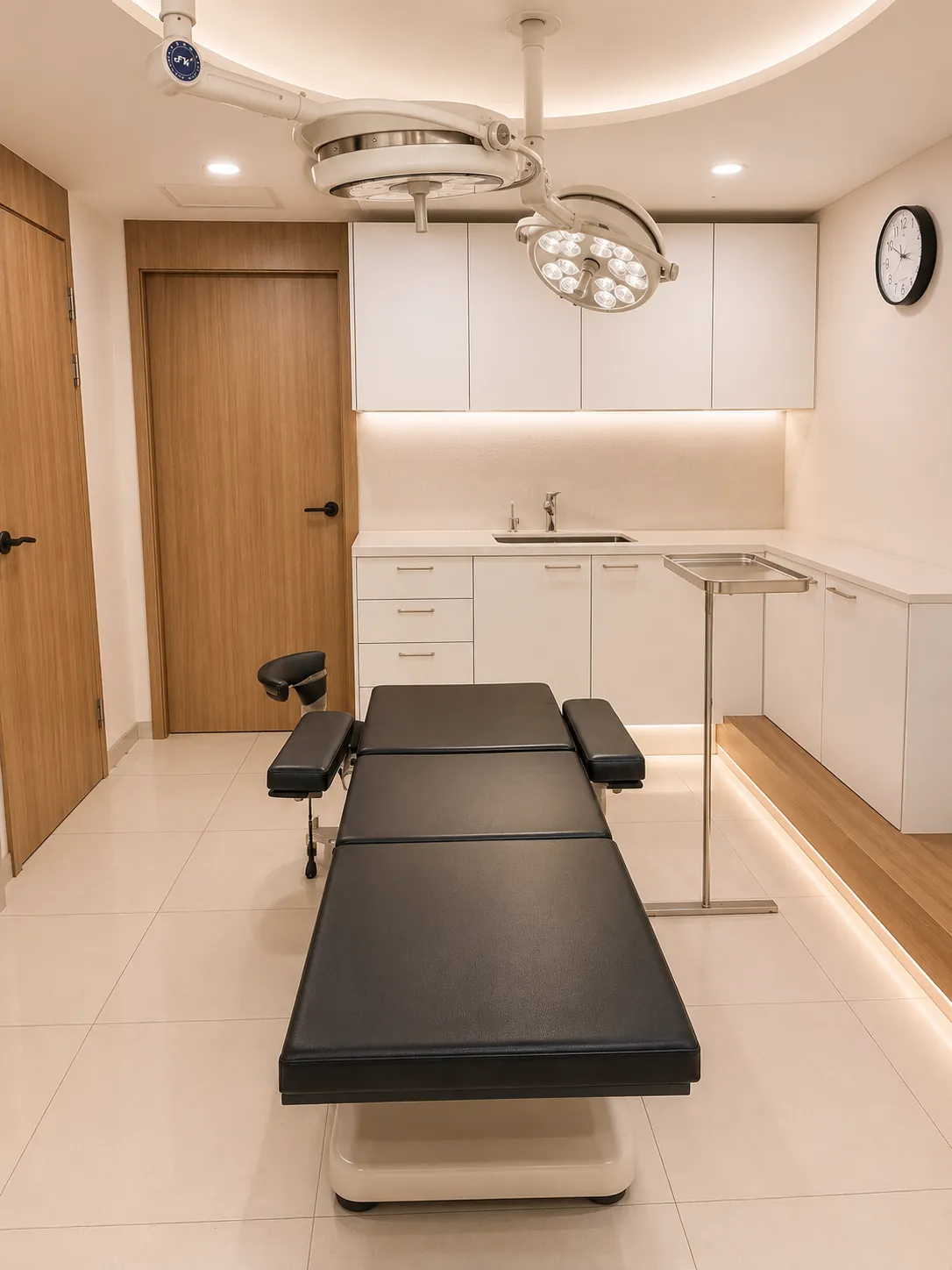
The reason this operation is performed under local anaesthesia is that the patient must be able to open their eyes during surgery. Lid height and curve are checked live, both sides compared, and adjusted before closing.
Terminology
What ptosis correction is also called
Searched as droopy eyelid surgery or ptosis repair. It raises the eyelid margin itself — a different problem from loose skin resting on the lashes.
- Levator advancement
- Levator resection
- Droopy eyelid correction
- Droopy eyelid surgery
- Ptosis repair
- Sleepy eye correction
If you were told one of these names abroad, you are on the right page — they describe the operation Dr. Lee performs as ptosis correction (눈매교정) here in Sinsa, Gangnam, Seoul.
Candidacy
Who this procedure is — and is not — for
We would rather turn an operation down than perform one that will not help you. These are the honest boundaries of this procedure.
A good candidate
- Eyes that look sleepy or half-closed in photographs
- Constant unconscious forehead lifting and deep horizontal brow lines
- One eye noticeably smaller or lower than the other
- Patients with an existing double eyelid whose eye still does not look open
Better served by something else
- Very poor levator function, which may need a different technique such as a sling
- Neurological or muscular causes of ptosis needing medical assessment first
- Severe dry eye without ophthalmological clearance
The detail that decides the result
Adjusted against an open eye
Ptosis surgery cannot be planned entirely in advance. Muscle behaves differently in every patient, swelling from local anaesthetic changes the picture, and the two sides rarely start equal.
Dr. Lee adjusts the lid against a live, open eye — repeatedly, comparing both sides — rather than resecting a pre-planned millimetre figure. It is slower. It is the only reliable way to land the height.
Surgical sequence
How ptosis correction is performed at SINSA L
Every step below is carried out by Dr. Lee Young-geun himself, from the first marking to the final suture.
Measure before anything else
Margin-reflex distance and levator function are measured, and the degree of compensatory brow lifting is noted, since it masks the true severity.
Crease incision access
Access is through the planned eyelid crease, so the ptosis correction and the crease are created through a single line.
Calculated advancement or resection
The levator aponeurosis or Müller's complex is shortened or advanced according to the measured function, not by a fixed amount.
Live intra-operative adjustment
The patient opens the eyes; height, curve and symmetry are checked and refined — the most important step of the operation.
Crease formation and closure
The crease is fixed at the chosen height and the wound closed with fine sutures.
Before & after
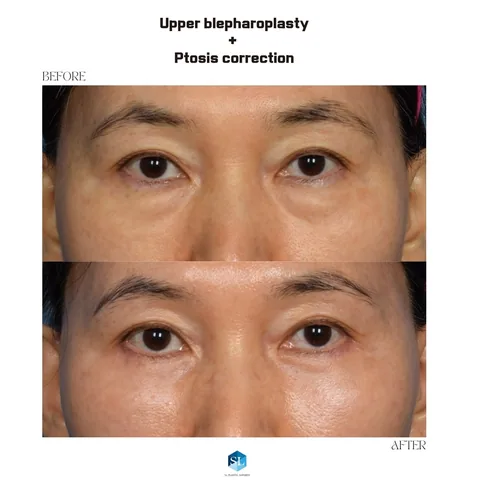
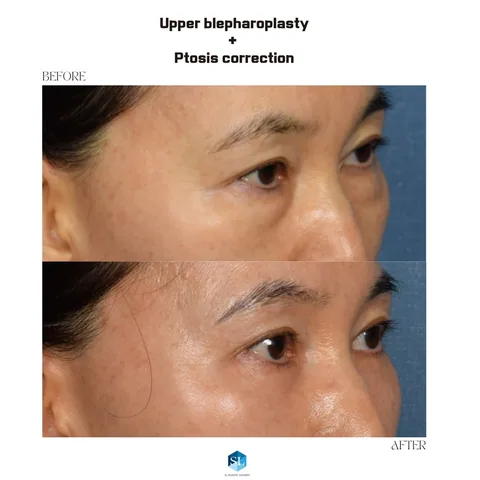
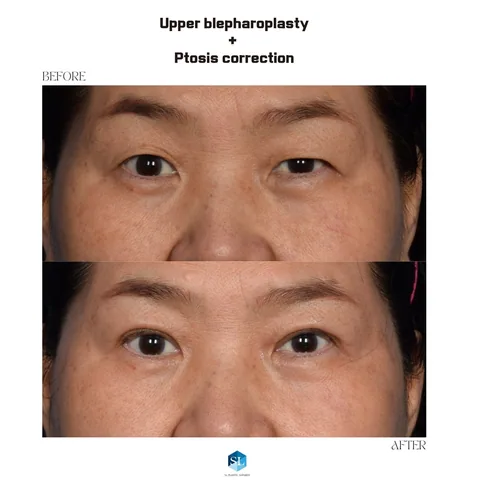
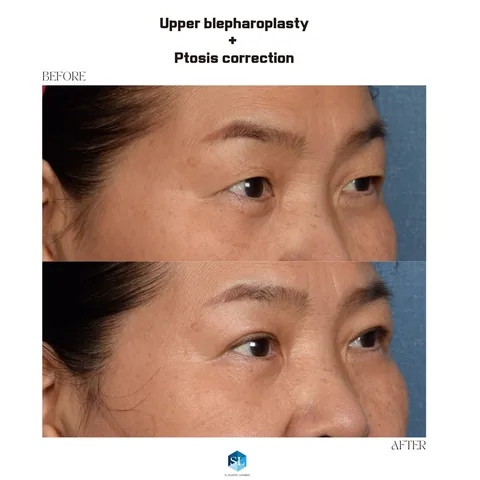
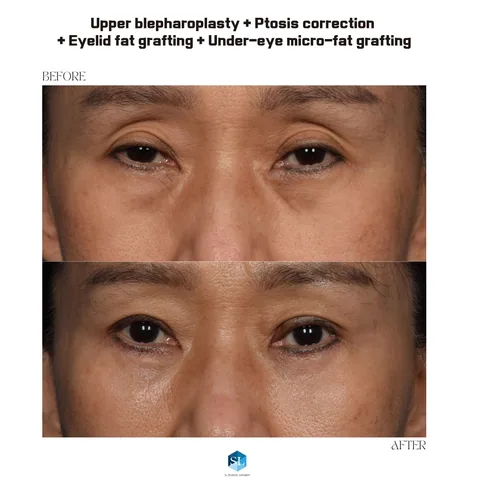
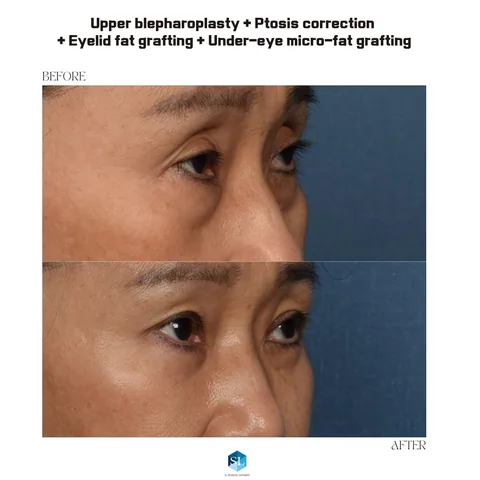
Ptosis Correction results, photographed the same way every time
Standardised distance, lighting and angle. Each photograph is a consented patient of SINSA L Plastic Surgery Clinic in Gangnam, Seoul, Korea, and every case shown was operated by Dr. Lee Young-geun himself.
Recovery
What the healing actually looks like
Timelines vary between patients. These are the ranges we tell our own patients to plan around — not best cases.
Every follow-up appointment is with Dr. Lee. If something worries you between visits, you reach the clinic directly — there is no call centre in between.
| Day 0-3 | Swelling is more pronounced than after a simple crease operation. |
|---|---|
| Day 5-7 | Sutures removed. The lid may look slightly over-corrected at this stage. |
| Week 2-4 | Swelling subsides and the lid begins to settle to its true height. |
| Month 1-3 | Final lid height and symmetry. |
Risks & honesty
What can go wrong
Swelling, bruising, under- or over-correction of lid height, asymmetry between sides, temporary difficulty closing the eyes, dryness, an unnatural lid curve, and the possibility of a revision. Intra-operative adjustment with the patient awake is the main safeguard.
Surgical results differ from person to person according to anatomy, skin quality, age and healing response. Every procedure carries risk, including bruising, swelling, asymmetry and the possibility of revision. The content on this site is general information, not a diagnosis or a guarantee of outcome. A face-to-face consultation with Dr. Lee is required before any operation is planned.
How the eyelid operations compare
Hooded skin, a missing crease and a droopy lid look similar but are different problems with different operations.
| Operation | Best for | What is changed |
|---|---|---|
| Upper blepharoplasty | Hooded eyelids where a skin fold rests on the lashes | Loose skin is removed, measured with the patient sitting up; the scar is hidden in the natural crease. It does not lift the lid margin. |
| Double eyelid surgery | No crease, or a crease that needs refining | The crease is created or refined by the buried-suture, partial-incision or full-incision method, chosen by lid thickness, skin and fat. |
| Ptosis correction | An eyelid margin that sits too low | The levator muscle that opens the eye is adjusted, with the height checked while the eye is open. |
FAQ
Ptosis Correction — frequently asked questions
What is the difference between ptosis correction and double eyelid surgery?
Double eyelid surgery creates a fold in the skin. Ptosis correction changes how far the eyelid opens by adjusting the muscle. If your eye looks sleepy rather than simply creaseless, a crease alone will not solve it.
Do I need to be awake?
Yes, for the critical part. It is performed under local anaesthesia so you can open your eyes on request and lid height can be adjusted against the real result.
Will my forehead wrinkles improve?
Often. Many patients stop unconsciously lifting the brow once the lid opens on its own, and the horizontal lines soften with time.
How long until it looks right?
The lid usually looks slightly over-corrected for two to four weeks while swelling resolves, then settles over one to three months.
Can it be revised if the height is not equal?
Yes, and a small adjustment is sometimes necessary. It is normally carried out once the lid has fully settled, at around three to six months.
What is the difference between a droopy eyelid and hooded eyelid skin?
A hooded eyelid is loose skin folding down from above while the lid edge itself sits normally. A droopy eyelid — ptosis — is the lid margin sitting low over the eye because the lifting muscle is weak or stretched. Removing skin will not fix ptosis, and adjusting the muscle will not fix loose skin. Getting that diagnosis right is most of the work.
Why is ptosis surgery done with the patient awake?
Because the only reliable way to judge how much to adjust the muscle is to have you open your eyes and look up during the operation. Under general anaesthesia the muscle cannot be tested, and the height has to be estimated. Local anaesthesia with the patient awake lets the lid height be checked, and corrected, before the operation is finished.
When can I fly home after ptosis correction?
Sutures are removed at day 5-7, and you fly after that review. Keep the return flight flexible by a day or two, because healing is not a schedule.
How much does ptosis correction cost?
The published standard fee is KRW 1,500,000 (about USD 1,120), the same for international and domestic patients. The final quotation depends on individual anatomy and is confirmed after examination by Dr. Lee.
Related
Often considered together
Double Eyelid Surgery
A crease that suits the face it is on. The method is chosen from the anatomy in front of us — eyelid thickness, skin, muscle strength…
상안검Upper Blepharoplasty
When upper eyelid skin descends far enough to rest on the lashes, the eye stops looking open and the forehead starts working overtime…
눈밑지방재배치Under-Eye Fat Repositioning
The operation this clinic was built around. Rather than cutting the bulging fat away, it is released and laid down into the hollow…
Consultation
Ask Dr. Lee whether ptosis correction is right for you
One surgeon, one consultation room. You will be examined and advised by the same person who would operate — in English, in person at the clinic in Sinsa.
Every consultation is carried out by Dr. Lee Young-geun in person — never by a coordinator.